How to see a Stave Church and a Viewpoint in one day in Norway?

How to see a Stave Church and a Viewpoint in one day in Norway?
You probably know the expression “to kill two birds with one stone”? In Norway we say “å slå to fluer i én smekk” (to hit two flies in one smack). And that is exactly what you can do with this tour departing Flåm; you can visit the stunning Borgund Stave Church AND the famous Stegastein viewpoint in one go.
Could you not just get there on your own? Well, keep in mind that you are in a remote part of Norway, there is little public transportation, everything is far apart, and unless you have a car, getting around can be quite a time consuming and complicated affair.
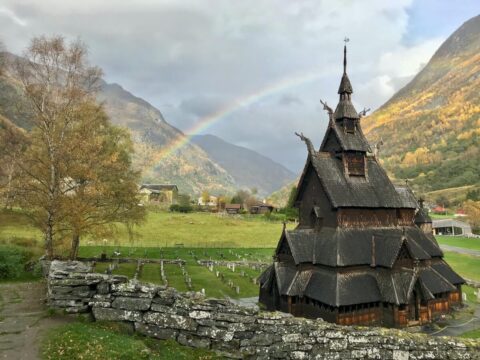
Borgund Stave Church
Bonus sights
On top of seeing the viewpoint and the Stave Church you’ll also get to drive the Lærdal tunnel which is the world’s longest road tunnel, stretching an impressive 24.5 kilometers (15.2 miles). You’ll also get to drive the Aurlandsfjellet scenic route, also known as “The Snow Road”, which is a 48-kilometer route between Aurland and Lærdal where you’ll experience dramatic landscapes and snow-capped vistas even in summer.
In this article I’ll give you some information about the sights on the tour, and lastly I’ll explain how to get to Flåm. I’m pretty sure after you’ve read to the end you’ll put these places on your bucket list for Norway.
Practical tips
- Note that prior to the clearing of Aurlandsfjellet mountain road and its reopening for the summer season (typically around June 1st), the tour does a round trip through the Lærdalstunnel.
- The tour includes your entrance ticket to Borgund Stave Church. An audio guide in English is also provided.
- If you are prone to car sickness, taking motion sickness medication beforehand is recommended.
- The bus is equipped with standard child seats. If you require one, please note this in your booking along with the child’s age.
- The best time for the full experience is typically between June 1st and October 15th, when the Aurlandsfjellet Scenic Route is clear of snow.
Stegastein Viewpoint
Okay, time to go up the mountain side!
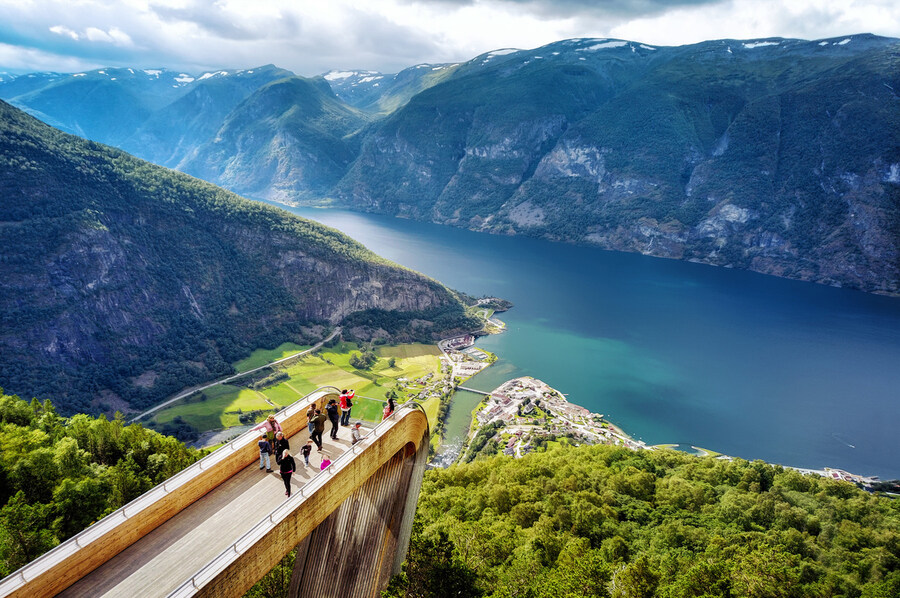
Heading to Flåm without experiencing the Stegastein Viewpoint is a bit like going to Paris without seeing the Eiffel Tower. The viewpoint is probably one of the most popular attractions in this area, and might be one of the most “instagrammable” spots as well. Once at the viewpoint you’ll get breathtaking panoramic views over the Aurlandsfjord and the surrounding hills and mountain tops.
The construction itself was designed by architects Todd Saunders and Tommie Wilhelmsen. The structure is a long, slender platform made primarily of laminated pine wood (glulam) and steel. It extends 30 meters (98 feet) out from the cliff face and is 4 meters (13 feet) wide.
At the end it curves gently upwards and then drops off abruptly, terminating in a sheet of clear glass, resulting in a dramatic sensation, as if it is floating above the fjord.
A goal of the architects was also to design it to be minimally invasive to the natural landscape, blending modern architecture with the rugged environment.
You might find it useful to know that there are toilet facilities on the top (which are also architecturally interesting, in keeping with the design philosophy of the Norwegian Scenic Routes).
–> Also check out this (Stegastein only) minibus tour to the top!
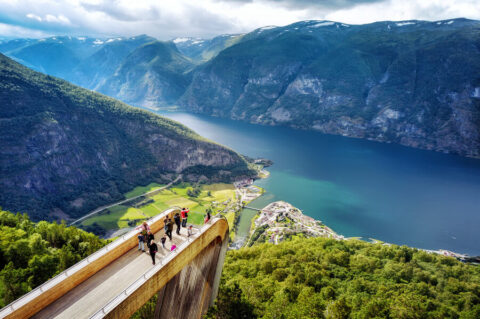
Stegastein Norway
Borgund Stave Church
Borgund Stave Church (Borgund stavkyrkje) is one of Norway’s most iconic and best-preserved stave churches. It’s an example of medieval Scandinavian wooden architecture. It’s located in the village of Borgund in Lærdal Municipality, Vestland county. The location of the church in a picturesque valley, for sure adds to its dramatic appearance.
When they radiocarbon dated some of the wood it suggested a felling date around 1180-1181 AD for some of the main timbers. The structure is largely held together with minimal use of iron nails.
You might find it interesting to know that the name “stave church” comes from its construction method. It uses large, upright wooden posts (staves or “staver” in Norwegian) as its primary load-bearing elements. These staves form the core framework, and the walls are made of vertical planks. This technique is distinct from log construction.
-
Architectural Features:
-
Tiered, Cantilevered Roofs:Borgund is famous for its distinctive, multi-tiered, steeply pitched roofs, designed to shed heavy snow and rain effectively.
-
Dragon Heads:Carved dragon / serpent heads sits on the gables of the roofs. These are reminiscent of Viking longship figureheads and likely served an apotropaic function (to ward off evil spirits) and also helped drain water away from the roof ridges.
-
Ambulatory:It has an exterior gallery or ambulatory (svalgang) running around the main structure, which provided shelter and may have been used for processions.
-
Intricate Carvings:The portals (doorways) and other wooden elements feature elaborate carvings, often depicting a mix of Christian iconography and pre-Christian Norse motifs (like intertwined animal figures and runic inscriptions).
-
-
Interior of the church:
-
The interior is dark and atmospheric, with few windows.
-
It retains many original features, including a medieval stone altar and a 13th-century pulpit.
-
The structural staves are clearly visible inside
-
-
Historical Significance:
-
Best Preserved:It is considered the best-preserved of Norway’s approximately 28 remaining stave churches (out of an estimated 1,000-2,000 originally built).
-
Transition Period:It was built during the period when Norway was transitioning from Norse paganism to Christianity. The blend of motifs in its carvings reflects this cultural shift.
-
Dedication:It was dedicated to the Apostle Andrew.
-
-
Current Status:
-
Museum:The church is no longer used for regular parish services but functions as a museum, although it is used for weddings every now and then. It is owned by the Society for the Preservation of Norwegian Ancient Monuments (Fortidsminneforeningen) since 1877.
-
Tourist Attraction:It’s a major tourist attraction, drawing visitors from around the world.
-
Visitor Centre:A modern visitor center nearby provides exhibitions, information, and facilities for tourists.
-
-
Influence:
-
Borgund Stave Church has served as an inspiration for numerous later buildings, including other stave church replicas and even elements in popular culture (e.g., it’s often cited as an inspiration for architecture in Disney’s “Frozen”).
-
Aurlandsfjellet Scenic Road
The Aurlandsfjellet Scenic Road is a popular road from Aurland to Lærdal, with some unforgettable experiences across a 47 kilometers stretch of stunning Norwegian landscape. You can expect spectacular scenery ranging from deep fjords to mountain peaks. The tour will make some additional photo stops along the Scenic Route Aurlandsfjellet.
Along this route, you will find:
-
Stegastein Viewpoint: This viewpoint mentioned earlier is located 650 meters above the Aurlandsfjord and provides a panoramic view of the fjord and surrounding mountains.
-
Flotane: Another architectural gem of a rest stop, features benches and a restroom integrated into the landscape
-
Vedahaugane: At Vedahaugane, you’ll find a bench and an “infinite” walkway, inviting you to take a break and soak in the views.
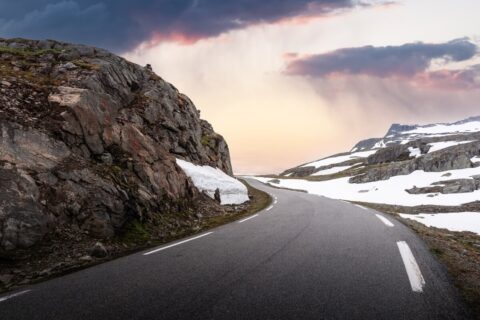
Aurland Scenic Road
Lærdal Tunnel
This tunnel is a 24.5-kilometer (15.2-mile) long road tunnel connecting Lærdal and Aurland in western Norway. Opened in 2000, it holds the title of the longest road tunnel in the world and serves as a vital ferry-free link on the main highway between Oslo and Bergen.
The drive through the tunnel takes approximately 20 minutes. To combat driver fatigue and monotony, the tunnel features three large mountain caves equipped with special blue and yellow lighting designed to mimic the colors of a sunrise. These illuminated caverns divide the journey into four sections, providing visual variety to help keep drivers alert.
Flåm – The Fjord Village
Flåm is a small village at the end of the Aurlandsfjord, part of the greater Sognefjord. Only about 350 people live there, but as a transportation hub for the Flåmsbana train, buses, fjord ferries and cruise ships, it can get quite crowded on a busy day.
That doesn’t necessarily mean you should avoid Flåm! The village is surrounded by natural beauty, there is a rich heritage, and tons of fun activities to try out.
Flåm is easy to get to from both Oslo and Bergen, and is the perfect starting point for exploring the heart of Norway’s fjord country. It’s also a convenient hub for accessing nearby destinations like Balestrand, Voss and Hardanger.
To get to Flåm I recommend joining either the
Both these tours can start and stop in either Bergen or Oslo. You can add nights in Flåm when you book, but typically 1-2 full days will be plenty. These tours are self-guided, but buying the tour through Fjord Tours will provide you with all the transportation tickets needed.
For more on Flåm check out my Ultimate Guide to Flåm article where you can find tips for accommodation, things to do and much more!
I hope you enjoyed this article, thanks for reading!
Your friend in Norway,
Pål

DISCLAIMER: Products on this page may contain affiliate links, and I might make a small sum per purchase. For you this does not affect the product price, but supports me and my work, and makes me able to continue sharing my passion for Norway with you. Read the Disclaimer policy. Thank you, tusen takk!
Join the Newsletter

Get my digital recipe book with seven traditional and tasty Norwegian delights!
Looking for something?
Join on Patreon

Become a part of the virtual viking Norway With Pål family, support, and get exclusive content and perks!
Donate on Paypal

Your support helps me to continue sharing my passion for Norway with you.
Tusen takk! Thank you!