
How I Make Perfect Norwegian Ribbe: Pål’s Ultimate Christmas Guide

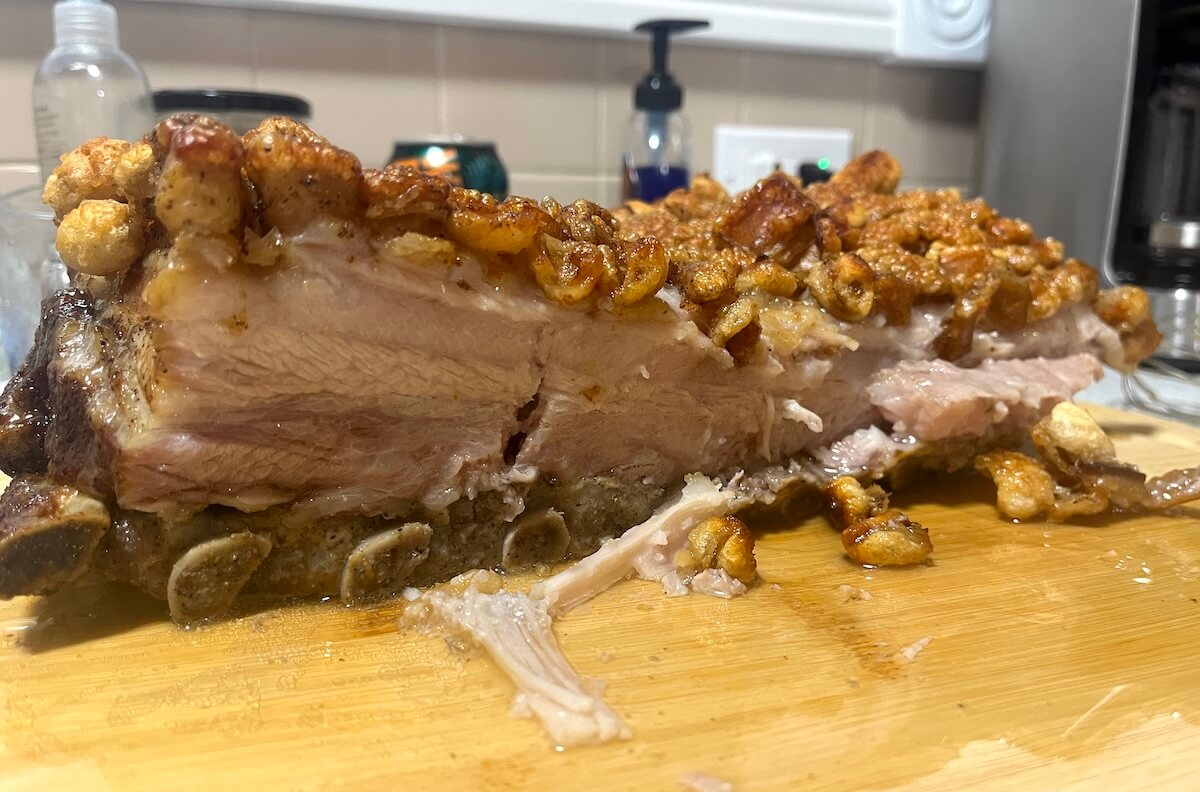
How I Make Perfect Norwegian Ribbe: Pål’s Ultimate Christmas Guide
Hei hei, in this post I want to teach you how Norwegians make ribbe (pork belly) for Christmas. I’ll explain how you can get the right cut from a butcher, how you prepare the cut before cooking it, and how to get a juicy ribbe with those very important sprø svor (crispy cracklings) on top.
Roughly 50% of Norwegians eat ribbe on Julaften (Christmas Eve), and the majority live in the eastern parts of Norway. It comes as part of a juletallerken (Christmas plate), on which you’ll typically find potatoes, cabbage (surkål, a type of sauerkraut), rødkål (red cabbage), gravy, julepølse (pork sausage), medisterkaker (pork patties) and tyttebærsyltetøy (lingonberry jam).
DISCLAIMER! Things on the plate can vary from family to family, but in this article I describe my way of doing it!
The Ribbe (pork belly) cuts
In Norway you can find the right pork belly cut in every supermarket from around the beginning of November until late December. This makes it easy for us Norwegians to get the right piece of meat, sometimes even seasoned and ready to go.
However, if you live abroad you might want to know how to describe the cut so that your butcher can provide you with the right piece.
To complicate things a bit, there are in general three different kinds of cuts:
1. Tynnribbe (Thin Ribs)
This is the gold standard for most Christmas dinners, and the one I’ll be using in this article. It consists of the side of the pork belly with the ribs still in, but without the loin.
- The Cut: Evenly thick, rectangular, and rich in fat layers.
- My tip: This is the easiest one to cook perfectly. Because it is flat and has a consistent thickness, it’s much easier to get that uniform, “Instagram-worthy” crispy crackling (svor) across the whole surface.
- Best For: Foodies and those who prioritize juicy meat and perfect crackling.
2. Familieribbe (Family Ribs)
This is a larger cut designed to satisfy a crowd with different tastes.
- The Cut: It includes the Tynnribbe plus a portion of the pork loin (kotelettkam). Crucially, in a “Familieribbe,” the backbone has been removed to make it easier to slice, but it still contains the rib bones.
- My tip: It’s great if you have guests who find the belly meat too fatty, as they can eat the leaner loin part. However, it’s harder to cook because one end is much thicker than the other.
- Best For: Large families or health-conscious guests who prefer leaner meat.
3. Juleribbe (Christmas Ribs)
This is where the marketing gets a bit tricky! “Juleribbe” is often used as a general term for Christmas ribs, but as a specific store cut, it’s a middle ground between the two above.
- The Cut: Like the Familieribbe, it includes the loin/ytrefilet, but it is often trimmed further. Usually, the rib bones in the loin section are removed entirely, leaving only the ribs in the “thin” part.
- My tip: Many supermarkets in Norway sell this as a “ready-to-go” premium option. It’s essentially a “boneless” version of the loin section attached to the traditional ribs, making it the easiest to carve at the table.
- Best For: People who want the variety of the Family Ribs but want the easiest possible carving experience.
Also check out my article about Lutefisk, another Norwegian Christmas dish.
Ordering ribbe from a butcher
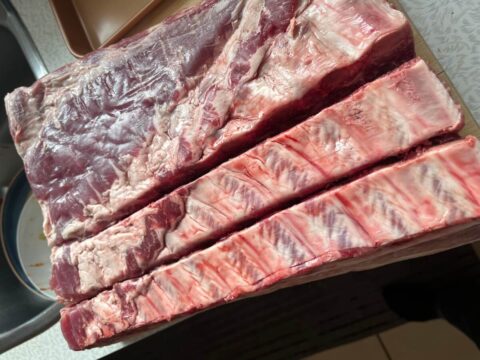
To get the tynnribbe (thin rib) from your local butcher, you simply order pork belly with the skin on and the bones on minus the loin. Specify that you need the bones to be cut (see image below), as it’ll make it much easier for you to cut the ribbe into pieces before serving it. You can also ask the butcher to make the square patterns in the skin (described later), but these are also easy to make yourself.
The good thing about ordering the cut from a butcher is that you’ll most likely get high-quality meat compared to cheaper types in the supermarket. Because if you want to get that perfect, juicy, and tasty ribbe, make sure you choose a piece with plenty of fat marbling.
How to prepare and cook the ribbe
In this article I’ll assume we have a 4 kilogram / 8.8 lbs heavy ribbe, about 6-7 centimeters (2.3–2.7 inches) thick. How long it will take to cook depends on the size of the cut and your oven. If you see the core temperature rise too fast you can slightly lower the heat, or the other way around.
You’ll also need:
- 3–4 tbsp Salt (coarse is best).
- 1–2 tbsp Black Pepper (coarse ground).
- 1 liter Water (approximately 4 and a quarter cups).
In this article I describe the slow-roasted method (langtidsstekt). This is widely considered the superior way to guarantee juicy meat, even if it takes all day. The entire cooking process will take about 7-8 hours, so plan accordingly to when your dinner guests arrive. Note that the ribbe also needs to rest about 20 minutes after it comes out of the oven.
This recipe was inspired by the NRK Langtidsstekt ribbe minute-by-minute TV show.
36–48 hours before roasting
- Wash the pork belly: Use running water to get all blood, meat debris etc.
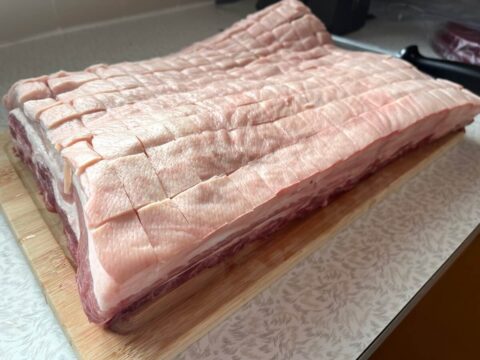
- Score the Skin: Use a sharp knife (or a box cutter/Stanley knife) to cut through the skin and into the fat layer, but try to not cut into the meat. Make a checkerboard pattern (squares).
- Season: Rub the salt and pepper thoroughly into the meat and specifically into the grooves of the skin.
- Rest: Wrap it up and leave it in the fridge for at least 24 hours, preferably 2-3 days. This draws out moisture from the skin (crucial for crispiness) and seasons the meat deep down.
Phase 1: Getting the skin ready
9:00 AM – The Scalding Process
- Preheat oven: 230°C (450°F) – Standard setting (not fan/convection yet).
- The Setup: Place the rib with the skin up in a deep roasting pan
- Boil Water: Bring the water to a boil with a level tablespoon of salt.
- Scald: Ladle the boiling water over the entire rind.
- Effect: This process coagulates the rind, causing it to harden and ensuring the scoring splays (opens up) slightly more.
- Turn the rib around so the skin side is down
- Cover: Seal the roasting pan tightly with aluminium foil. You want to create a steam chamber.
- Steam: Roast for 45 minutes. This prepares the skin for that crispiness later on.
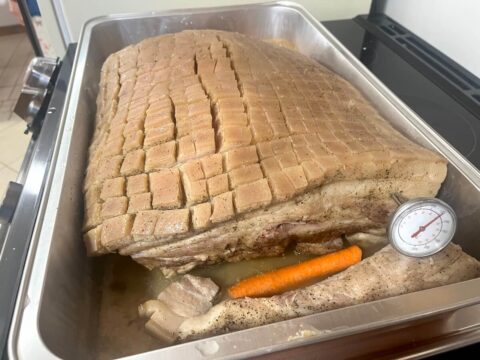
The 7-Hour Slow-Roast Pork Belly (Ribbe) Timeline
10:00 AM – The Initial Roast
- Lower the oven temperature to 170°C (340°F). Do not use the fan/convection setting yet.
- Flip the meat so the skin (rind) side is facing up.
- Pro tip: Crucial Step: Place a small upside-down bowl (oven-safe) or a ball of crumpled aluminum foil underneath the meat. This creates an arch (like a bridge) which allows fat to drain off and helps the skin crisp up evenly later.
- Insert your meat thermometer into the thickest part of the meat.
- Place the pork belly in the oven (without any foil covering it).
- Roast for one hour.
- Target: By the end of this hour, the internal temperature should be approximately 70°C (158°F).
11:00 AM – The Long Slow Roast
- Lower the oven temperature to 90°C (195°F). If your oven has a fan/convection setting, turn it on now.
- Leave it to roast slowly for four hours ish.
- Target: The internal temperature will rise very slowly during this time, aiming for 85°C (185°F) by the end.
3:00 PM (15:00) – Add Vegetables
- Increase the oven temperature to 110°C (230°F).
- Current internal temp: Approx. 85°C (185°F).
- Pro tip: if the internal temp is much lower at this point raise the oven temperature a bit more to speed up the process
- Scatter your peeled and roughly chopped root vegetables into the pan around the meat.
4:00 PM (16:00) – Increasing Heat
- Increase the oven temperature to 150°C (300°F).
- Target internal temp: Approx. 90–92°C (194–198°F).
4:30 PM (16:30) – The Final Push
- Crank the heat up to 210°C (410°F).
- Target internal temp: Approx. 96°C (205°F).
- Warning: Every oven is different. Keep a close eye on the meat now to ensure the skin doesn’t burn.
4:45 PM (16:45) – The Crackling
- Turn the temperature to max!
- Watch carefully! This step is to make the crackling “pop” and puff up. Do not walk away, or it might char.
- Let the rib in the oven until the skin has popped all over.
4:50 PM (16:50) – Resting
- Take the meat out of the oven.
- Pro tip: Let the meat rest on the counter (uncovered) for at least 20 minutes before carving. This keeps the juices inside.
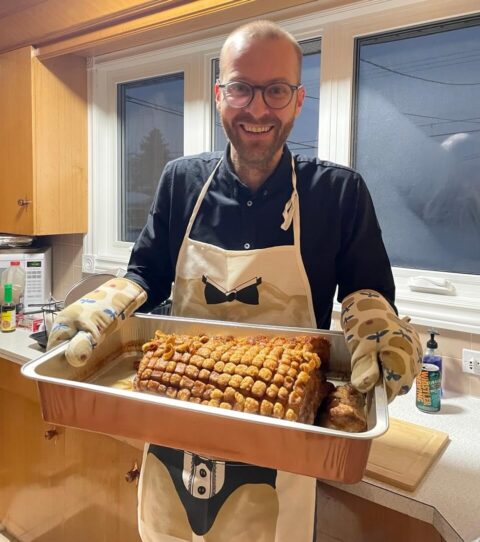
5:10 PM (17:10) – Dinner Time
- Serve and enjoy!
- Observe the guest’s pure joy of the juicy meat and crispy cracklings (hopefully) 🙂
I recommend a dark ale or red wine, and some aquavit (Scandinavian distilled spirit) to go with the dish. And why not make a traditional riskrem (rice cream pudding) for dessert?
God jul, Merry Christmas!
Your friend in Norway,
Pål

DISCLAIMER: Products on this page may contain affiliate links, and I might make a small sum per purchase. For you this does not affect the product price, but supports me and my work, and makes me able to continue sharing my passion for Norway with you. Read the Disclaimer policy. Thank you, tusen takk!
1 Comment
Leave a Comment
Join the Newsletter

Get my digital recipe book with seven traditional and tasty Norwegian delights!
Looking for something?
Join on Patreon

Become a part of the virtual viking Norway With Pål family, support, and get exclusive content and perks!
Donate on Paypal

Your support helps me to continue sharing my passion for Norway with you.
Tusen takk! Thank you!


Thank you!!!